A short history of the Vasari Corridor, 1565 to 2024
Official ticket firstUffizi plus corridor costs €47 on the museum’s own site. The options below sell a guide for the paintings, or a slot when the official ones are gone.
Compare all six1565: a wedding and a cautious duke
Florence had become a hereditary Medici duchy in the 1530s, and Cosimo I governed cautiously. When his son Francesco was to marry Joanna (Johanna) of Austria, Cosimo had Giorgio Vasari build a covered passage from the family residence at Palazzo Pitti, across the river, to Palazzo Vecchio, where the government sat. It went up in about five months. The Uffizi gives the year as 1565; Wikipedia says it was commissioned in 1564. There was a precedent for a raised private passage: Rome’s Passetto di Borgo.
Two neighbours who would not move
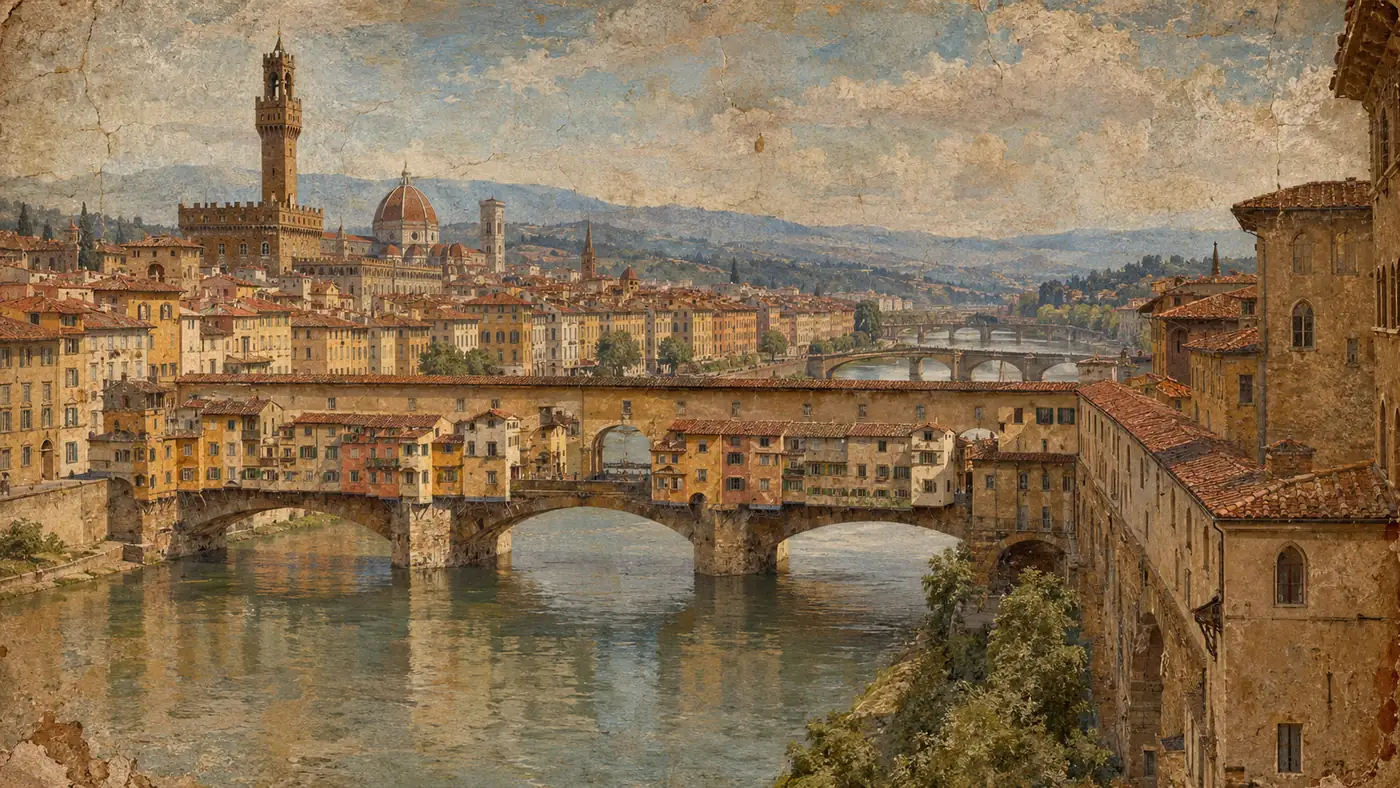
The route runs from Palazzo Vecchio through the Uffizi, along the Arno and over the Ponte Vecchio above the shops. On the far bank it meets the Mannelli Tower. The Mannelli refused to let it be demolished, so the corridor goes round it on stone brackets, a duke’s detour that is still there. Then it passes over the portico of Santa Felicita, where a balcony opens into the church so the ducal family could hear Mass unseen, and over the Oltrarno houses to Boboli and Pitti.
Butchers out, goldsmiths in
The shops on the Ponte Vecchio were butchers, and the smell rose. They were moved out and replaced by goldsmiths, who were established there by 1593, according to Wikipedia, and are there still. When you walk the bridge today you are walking under the reason for it.
A gallery of faces
In the mid-17th century Cardinal Leopoldo de’ Medici began collecting self-portraits. The collection hung in the corridor from the 1970s until 2016, and the corridor opened to the public, according to Wikipedia, in 1974. Many people still picture it that way. The self-portraits are not back, and the Uffizi says so on its history page.
The windows over the bridge
The wide panoramic windows above the Ponte Vecchio are widely reported to have been opened for Hitler’s visit to Florence with Mussolini in May 1938. I repeat it because every guide in the city does, but I treat it as a story told about the windows rather than a documented fact.
War, flood and a bomb
The corridor was damaged in the bombing of Florence in the Second World War (Wikipedia says 1943), and again by the Arno flood of 1966. On 27 May 1993 a Mafia car bomb in Via dei Georgofili killed five people and damaged the end of the corridor nearest the Uffizi. That section reopened in 1998. More recently, in August 2023, seven pilasters were covered in graffiti.
Closure and the 2024 reopening
The corridor closed in 2016 to bring it up to safety standards. Works started in 2022, cost about 10 million euros, and were helped by one million dollars donated in 2023 by the US entrepreneur Skip Avansino. The corridor reopened on 21 December 2024 with ramps, platforms and lifts, LED lighting, video monitoring, five new emergency exits and air conditioning, restored in the museum’s words to its “original bareness”.
Since July 2025 more than fifty Roman portrait busts, in storage since 1993, line the section above the Ponte Vecchio. What the walk looks like now, stop by stop, is on what you see, and whether it is worth your money is on is it worth it.
Frequently asked questions
Who built the Vasari Corridor, and why?
Giorgio Vasari, in 1565, for Cosimo I de’ Medici, in about five months, for the wedding of Cosimo’s son Francesco to Joanna of Austria. It let the duke move between Palazzo Pitti and Palazzo Vecchio without going through the streets.
Were the big windows made for Hitler?
That is the story, and it is widely reported: the panoramic windows over the Ponte Vecchio are said to have been opened for Hitler’s visit with Mussolini in May 1938. Treat it as a story rather than established fact.
Are the self-portraits still in the Vasari Corridor?
No. They hung there from the 1970s until 2016 and have not returned. Since July 2025 the section above the bridge has Roman portrait busts instead. What is there now.
When did the Vasari Corridor reopen?
On 21 December 2024, after closing in 2016 for safety works. You can book it on the official site; here is how.